
AI with Human Touchpoints in Customer Experience
How do you know you have the right balance between tech and personalization?

Customer experience is a top priority for businesses looking to stay ahead of the competition. With advancements in technology, companies are turning to artificial intelligence (AI) to enhance their customer experience (CX). However, with the rise of AI, there are concerns about losing the human touch that makes a CX memorable. This week we are exploring the importance of integrating AI with human touchpoints in customer experience, and how businesses can find the right balance for a seamless CX.

First, let's understand the benefits of AI in customer experience. AI can help businesses provide faster, more personalized, and efficient customer support. Chatbots, for example, can assist customers 24/7, handling simple inquiries, and providing quick resolutions. AI-powered personalization can also tailor product recommendations and communication based on the customer's history and preferences. Moreover, AI can help businesses analyze customer data, gain insights, and make data-driven decisions.
While AI has its benefits, it cannot replace the human touch that makes a CX memorable. Customers value human interaction, empathy, and understanding. They appreciate the emotional connection and trust that comes with speaking to a human representative who understands their concerns and is willing to help. Hence, businesses must find a way to integrate AI with human touchpoints to create a seamless CX.
One way to achieve this is to use AI to enhance human interactions. For example, AI-powered chatbots can collect customer information and data, enabling human agents to pick up where the bot left off, saving time and increasing efficiency. Chatbots can also route customers to the right department or agent, reducing wait times and frustration. AI can also provide human agents with insights into the customer's history, preferences, and behavior, enabling them to provide personalized recommendations and a better overall experience.
Another way to integrate AI with human touchpoints is to use it to augment human skills. For instance, AI can help human agents process information faster and more accurately, reducing errors and increasing productivity. AI-powered language translation can also help businesses communicate with customers who speak different languages. Moreover, AI can help human agents to stay on top of customer inquiries, providing quick and accurate answers to complex questions.
However, to integrate AI and human touchpoints effectively, businesses must find the right balance. They must ensure that AI does not take over human interactions completely. Instead, AI should complement human interactions, providing value and enhancing the customer experience. The key is to use AI to automate simple, repetitive, and low-value tasks, freeing up human agents to focus on more complex and high-value interactions.
To achieve the right balance, businesses must also understand their customers' needs and preferences. They must identify which touchpoints are most important to their customers and how they can use AI to enhance those touchpoints. For example, some customers may prefer to speak to a human agent when dealing with complex issues, while others may prefer the convenience of self-service options powered by AI.
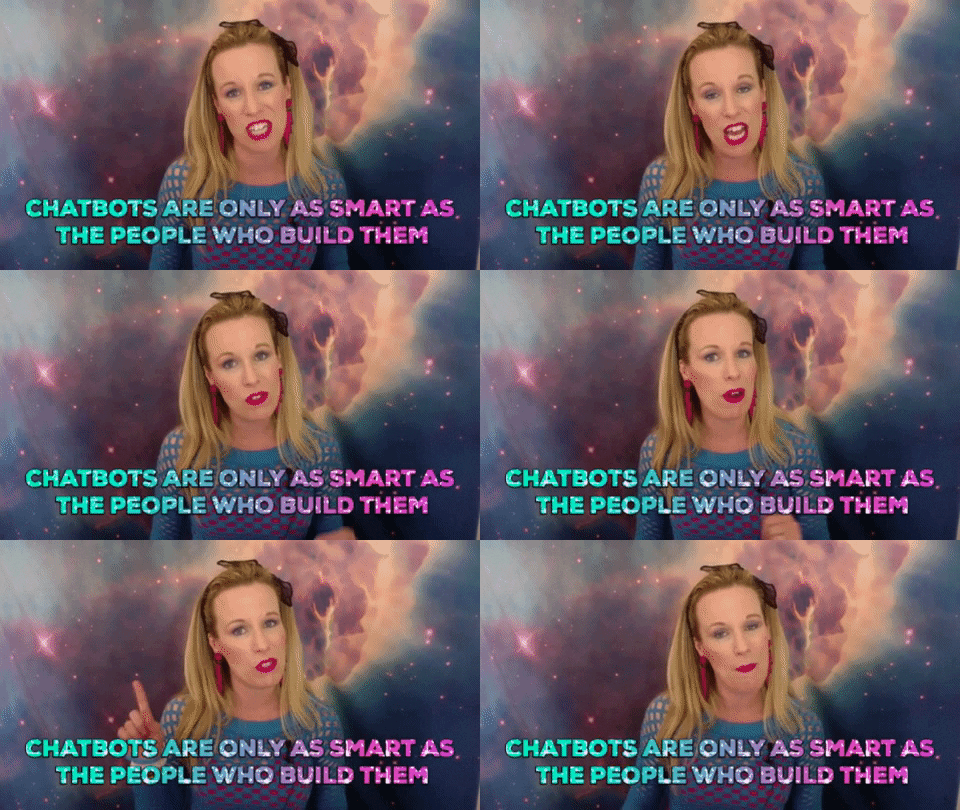
Moreover, businesses must ensure that their AI solutions are user-friendly, accessible, and transparent. Customers must know when they are interacting with an AI-powered system and when they are speaking to a human agent. They must also have the option to escalate their inquiry to a human agent if they need to. Additionally, businesses must ensure that their AI systems are designed to protect customer data and privacy.
AI is an essential tool for businesses looking to enhance their customer experience. However, to create a memorable CX, businesses must integrate AI with human touchpoints effectively. They must use AI to enhance human interactions, augment human skills, and automate low-value tasks. Moreover, they must find the right balance between AI and human touchpoints, understanding their customers' needs and preferences. Ultimately, the key to a seamless CX is to use AI to complement human interactions, providing value and enhancing the overall customer experience